Photo of Azim ChowdhuryPhoto of Josephine Hsu

On April 26, 2022, the U.S. Food and Drug Administration (FDA) authorized an additional four tobacco-flavored electronic nicotine delivery system (ENDS) products for marketing under the Premarket Tobacco Product Application (PMTA) pathway. Marketing granted orders (MGOs)[1] were issued for the following NJOY tobacco-flavored ENDS products:

  • NJOY Ace Device: Closed e-cigarette device
  • NJOY Ace Pod

Photo of Azim ChowdhuryPhoto of Josephine HsuPhoto of LieAnn T. Van-Tull

FDA Premarket Tobacco Product Application (PMTA) Pathway

Under FDA’s premarket tobacco product application (PMTA) pathway, manufacturers or importers of tobacco products must demonstrate to the U.S. Food and Drug Administration (FDA) that the marketing of a new tobacco product would be appropriate for the protection of the public health (APPH). See Section 910(c)(2)(A) of the

Photo of Azim ChowdhuryPhoto of Neelam Gill

Keller and Heckman Partner Azim Chowdhury and Associate Neelam Gill published an article for the Food and Drug Law Institute (FDLI) titled, “Will FDA Extend Its Proposed Ban on Menthol Cigarettes and Characterizing Flavors in Cigars to Flavored ENDS Products?” The article discusses FDA’s recent announcement to initiate a rulemaking to ban menthol cigarettes, as

Photo of Azim Chowdhury

A new paper co-authored by fifteen past presidents of the Society for Research on Nicotine and Tobacco (SRNT) and published in the American Journal of Public Health encourages the media, legislators, and the general public to re-evaluate negative attitudes toward vaping. Kenneth Warner, lead author and dean emeritus and the Avedis Donabedian Distinguished University Professor

Photo of Azim ChowdhuryPhoto of Kathryn Skaggs

Ahead of the Food and Drug Law Institute’s (FDLI) annual Tobacco and Nicotine Products Regulation and Policy Conference in Washington, DC, on October 23, 2019, Keller and Heckman attorneys Ben Wolf and Kathryn Skaggs presented on FDA’s “Pathways to Market” for new tobacco products during the pre-conference seminar, Introduction to Tobacco and Nicotine Law and

Photo of Azim Chowdhury

On February 21, 2019, FDA released the second of two draft guidance documents related to the development of novel nicotine replacement therapies (NRT).  The first draft guidance document, Nonclinical Testing of Orally Inhaled Nicotine-Containing Drug Products Guidance for Industry is available here, and the second draft guidance document,  Smoking Cessation and Related Indications: Developing

Photo of Azim Chowdhury

A major study found that e-cigarettes were twice as effective in helping people quit smoking than nicotine replacement therapies—such as patches, gum, and nasal spray—when both methods were accompanied by behavioral support. The randomized study involved 886 adults who were attending the U.K. National Health Service stop-smoking services.

Study participants were randomly given either nicotine-replacement

Photo of Azim Chowdhury

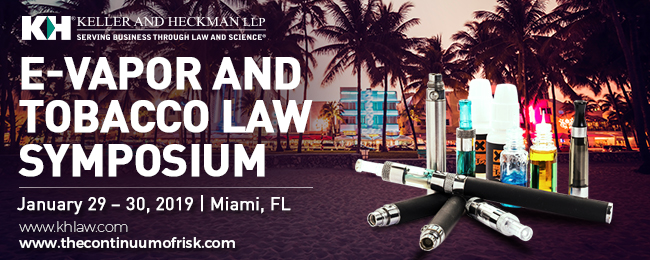
Keller and Heckman is pleased to announce the agenda for this year’s E-Vapor and Tobacco Law Symposium. This comprehensive 2-day course will provide you with guidance on how to stay in compliance with FDA’s recent announcements and much more. Click here to view the agenda.

Topics that will be covered include: FDA and State law

Learn how to stay in compliance with FDA’s recent announcements and much more at Keller and Heckman’s upcoming E-Vapor and Tobacco Law Symposium on January 29 – 30, 2019, in Miami, Florida. Below is a sampling of topics that will be covered at the event. Sign up now and take advantage of our early bird

Photo of Azim Chowdhury

Following a series of actions over the last several months, on November 15, 2018, the U.S. Food and Drug Administration (“FDA”) announced new steps aimed at protecting youth from tobacco, including, among other things, preventing access to flavored electronic nicotine delivery system (“ENDS”) sold in certain retail locations, and potentially banning menthol in combustible tobacco