
On June 30, 2026, FDA issued modified risk granted orders to Swedish Match USA, Inc., a wholly owned subsidiary of Philip Morris International Inc., for 20 ZYN nicotine pouch products, authorizing the company to market those products with the claim: “Using ZYN instead of cigarettes puts you at a lower risk of mouth cancer, heart

FDA Proposes Long-Awaited Rule to Require Foreign Tobacco Manufacturers to Register Establishments and List Products
On June 26, 2026, the U.S. Food and Drug Administration (FDA), Center for Tobacco Products (CTP), announced a proposed rule titled “Establishment Registration and Product Listing for Tobacco Products” that, if finalized, would require foreign tobacco product manufacturing establishments to register with FDA and list tobacco products manufactured for import into the United
Maine Enacts First-in-the-Nation EPR Law for Electronic Smoking Devices
On April 23, 2026, Maine enacted Public Law Chapter 769, An Act to Create a Stewardship Program for Electronic Smoking Devices and Related Products, codified at 38 M.R.S.A. § 1618. The law appears to make Maine the first U.S. state to enact an extended producer responsibility (EPR) law specifically targeting “electronic smoking devices.” Once the
FDA’s New ENDS and Nicotine Pouch Enforcement Guidance: Lower Priority for Post-November 2021 Reviewable Applications, Higher Scrutiny for Illicit Products
On May 8, 2026, the U.S. Food and Drug Administration (FDA) issued final guidance describing how the Agency intends to prioritize enforcement for certain unauthorized electronic nicotine delivery systems (ENDS) and oral nicotine pouch products marketed without premarket authorization. The guidance is effective immediately and replaces FDA’s prior April 2020 ENDS enforcement-priorities guidance.
Critically
FDA Authorizes Glas Flavored ENDS Products, Opening an Age-Gating Pathway for Flavors
On May 5, 2026, the U.S. Food and Drug Administration (FDA) issued marketing granted orders (MGOs) for four Glas closed-pod electronic nicotine delivery system (ENDS) products: Classic Menthol, Fresh Menthol, Gold (mango), and Sapphire (blueberry). The authorization is a significant development for the ENDS industry because the Gold and Sapphire are FDA’s first authorized non-tobacco
Pennsylvania’s New ENDS Directory Law Raises the Bar for Market Access

Pennsylvania has joined the growing group of states that condition ENDS sales on federal PMTA status. Enacted as Act 57 of 2025, House Bill 1425 adds Section 206-I to The Fiscal Code and directs the Pennsylvania Attorney General to maintain a directory of electronic cigarettes that may be sold in the Commonwealth. The law ties
How FDA Can Better Align Its Draft Guidance on Flavored ENDS with the Tobacco Control Act’s APPH Mandate
As discussed in our earlier post, the U.S. Food and Drug Administration’s (FDA) new draft guidance on flavored electronic nicotine delivery system (ENDS) products represents a meaningful effort to provide additional clarity about the Agency’s evidentiary expectations for premarket tobacco product applications (PMTAs). That clarity is welcome. At the same time, the draft guidance
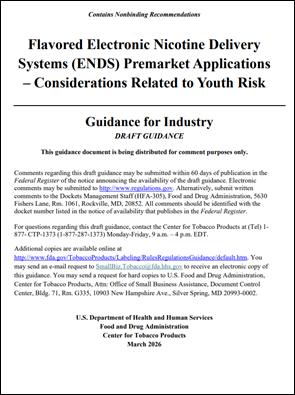
FDA Formalizes a Flavor-Specific PMTA Framework as Youth Vaping Continues to Decline
On March 9, 2026, the U.S. Food and Drug Administration (FDA) issued a new draft guidance for industry, Flavored Electronic Nicotine Delivery Systems (ENDS) Premarket Applications – Considerations Related to Youth Risk, clarifying how the agency evaluates whether a non-tobacco-flavored electronic nicotine delivery system (ENDS) product is appropriate for the protection of the public

Agenda Announced – Keller and Heckman’s 10th Annual E-Vapor, Nicotine, and Tobacco Law Symposium
We are pleased to announce the agenda for Keller and Heckman’s 10th Annual E-Vapor, Nicotine, and Tobacco Law Symposium, being held Monday, May 4 – Tuesday, May 5, 2026, in Las Vegas, Nevada, right before the CHAMPS Trade Show! Click here to view the full program agenda.
Click here to register and save
China State Tobacco Monopoly Administration Expands Oversight to Nicotine Pouches and Smokeless Products
On January 9, 2026, China’s top tobacco regulator, the State Tobacco Monopoly Administration (STMA), published Announcement No. 1 of 20261, officially incorporating nicotine pouches and other “smokeless tobacco products” into its regulatory framework. According to the Announcement, “smokeless tobacco products” refer to tobacco products containing nicotine that are used orally, nasally, or externally