
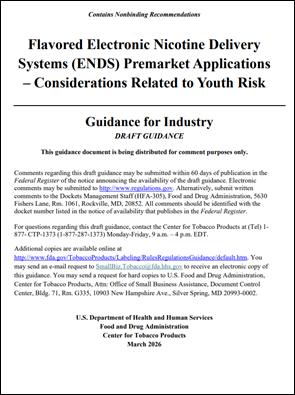


On March 9, 2026, the U.S. Food and Drug Administration (FDA) issued a new draft guidance for industry, Flavored Electronic Nicotine Delivery Systems (ENDS) Premarket Applications – Considerations Related to Youth Risk, clarifying how the agency evaluates whether a non-tobacco-flavored electronic nicotine delivery system (ENDS) product is appropriate for the protection of the public health (APPH) under section 910 of the Family Smoking Prevention and Tobacco Control Act. In particular, the draft guidance addresses the type and quantum of scientific evidence FDA expects applicants to submit to offset youth-risk concerns associated with different ENDS flavor categories.
Despite acknowledging that flavored ENDS may provide public health benefits for adult smokers, FDA makes clear that its underlying framework for premarket tobacco product application (PMTA) review remains the same. Since adopting its comparative-efficacy / fatal flaw review approach in 2021 and following the Supreme Court’s decision in FDA vs. Wages, the agency has taken the position that applications for flavored ENDS products must show an added benefit over tobacco-flavored ENDS—specifically, that the flavored product is comparatively more effective in helping adult smokers switch from combustible cigarettes or substantially reduce daily cigarette consumption. That requirement reflects FDA’s general presumption that all flavored ENDS pose greater risks to youth than tobacco-flavored products. The new draft guidance does not alter that premise; instead, it seeks to clarify how much adult-benefit evidence is necessary, with FDA stating that the amount of adult-benefit evidence needed should vary depending on the flavor category’s relative youth appeal.
FDA thus embraces a graduated, risk-proportionate approach. Put simply, flavor categories the agency believes have the greatest appeal to youth (e.g., fruit and candy/dessert/other sweet flavors) will carry the heaviest evidentiary burden. By contrast, flavors for which there may be reliable scientific evidence of relatively lower youth appeal, such as menthol, mint, and perhaps certain mature flavors like spice, tea, coffee, etc., may satisfy the APPH standard and comparative efficacy requirement with a more modest incremental showing of adult benefit.
On the youth-risk side, the draft guidance relies heavily on the proposition that flavored ENDS have been a principal driver of youth initiation and sustained use. FDA points to the National Youth Tobacco Survey (NYTS) data and other literature to support the view that young people who vape overwhelmingly use flavored products, that fruit is the leading flavor category, and that non-tobacco flavors are associated with higher odds of continued use.
Specifically, the agency underscores that youth who prefer fruit flavors are approximately twice as likely to report ENDS as their first tobacco product compared to those with other flavor preferences. Conversely, youth preferring “traditional” (menthol, mint, or wintergreen) flavors were half as likely to have tried ENDS first. Furthermore, the agency highlights that youth who use non-traditional flavors (e.g., fruit and candy) have nearly four-fold higher adjusted odds of continued vaping six months later compared with those using only traditional flavors (tobacco, menthol or mint, or flavorless). This indicates that the agency is now explicitly differentiating between “traditional” and “non-traditional” flavors in its public-health analysis for ENDS.
Notably, however, the draft guidance does not account for the newly released 2025 NYTS data, which indicate that youth vaping rates have continued to decline substantially from their 2019 peak, falling to 5.2% among middle and high school students combined, 7.1% among high school students, and 2.6% among middle school students.
| NYTS Survey (Year) | Percentage of High School Students Reporting Current ENDS Use |
| 2025 | 7.1% |
| 2024 | 7.8% |
| 2023 | 10.0% |
| 2022 | 14.1% |
| 2021 | 11.3% |
| 2020 | 19.6% |
| 2019 | 27.5% |
(“Current use” is defined by the NYTS to mean use on ≥1 day during the previous 30 days. In other words, students who vape only once in the past month would be defined as a current user.)
On the adult-benefit side, FDA concedes that non-tobacco flavors may provide meaningful benefits for adults attempting to transition away from combustible cigarettes, whether by encouraging complete switching, supporting abstinence, or reducing cigarette consumption. Although the agency cautions that the existing literature is mixed in places and that adult preferences are not monolithic, the draft guidance nonetheless recognizes that certain flavor categories may be particularly important for specific groups of adult smokers. That acknowledgment is especially significant because it leaves open the possibility that applicants can justify particular flavored products with evidence tailored to the needs and preferences of defined adult smoker subpopulations, including menthol smokers who may prefer menthol-flavored ENDS over tobacco-flavored alternatives.
Historically, FDA’s PMTA denial decisions and public statements often indicated that the type of evidence most likely to satisfy the agency’s comparative-efficacy framework would be product-specific evidence from a randomized controlled trial (RCT), a longitudinal cohort study (LCS), or other similarly robust and reliable evidence showing that a flavored ENDS product provides an added benefit over a tobacco-flavored comparator in promoting switching or significant cigarette reduction. The new draft guidance does not abandon that approach, but it does explicitly recognize non-clinical sensory data as a potentially more efficient path to characterizing the relative appeal of proposed flavors across youth, young adults, and adults. Specifically, FDA recommends that applicants submit scientifically valid evidence characterizing the relative appeal of proposed flavors and identifies sensory perception and consumer response studies, including blinded sensory panel assessments, as potentially useful tools for doing so without requiring actual product use. The agency further recommends that such studies use benchmark flavors such as tobacco, fruit, candy, and other common categories so the proposed flavor can be evaluated in context. In FDA’s view, that approach can capture sensory responses to the actual chemical compounds used in ENDS while eliminating direct exposure from vaping. Notably, while the draft guidance opens the door to this type of evidence, it stops short of requiring studies on minors themselves, instead recognizing that ethical and regulatory considerations may warrant the use of young adults ages 18 to 21 as a proxy for youth-relevant sensory responses.
The draft guidance also addresses novel device access restrictions (DARs) designed to “age gate” and prevent underage access to ENDS products. As reflected in prior FDA PMTA review documents, the agency had previously taken the position that traditional marketing, advertising, and sales-access restrictions were not sufficient to mitigate youth risk for flavored ENDS, and that only so-called “novel” or “materially different” mitigation measures—namely, device-based access restrictions—appeared to have meaningful mitigation potential. The new draft guidance preserves FDA’s interest in those technologies, but states that it will consider DARs (including technologies such as biometric unlocking and geofencing) as part of the overall APPH analysis, yet makes clear that DARs are unlikely to be sufficient on their own for highly youth-appealing flavors. In particular, FDA explains that applicants seeking authorization for products in categories such as fruit and candy/dessert/other sweet flavors face an especially high burden if they rely solely on DAR technology, and that DARs without adequate and substantial supporting evidence will not overcome the agency’s heightened youth-risk concerns for those flavor categories.
The agency also emphasized that it performs a holistic evaluation of PMTAs, and that its APPH assessment is not just about youth initiation and adult switching rates, but also a broader look at the potential public health risks and benefits to the population as a whole, including product-specific risks such as exposure to harmful or potentially harmful constituents (HPHCs).
In the end, the draft guidance does not ease FDA’s underlying skepticism toward flavored ENDS, but it does make the rules of engagement clearer. FDA is formalizing a flavor-specific, risk-proportionate framework under which the evidentiary burden rises with the agency’s assessment of a flavor’s likely youth appeal. At the same time, it remains to be seen whether FDA will revisit or recalibrate that framework in light of the recent NYTS data discussed above, which indicate that youth vaping continues to decline, and the broader body of evidence suggesting that flavors may not be the sole, and perhaps not even the primary, driver of youth experimentation and use. CDC itself notes that youth vaping is influenced by multiple factors, including social influences, marketing, nicotine effects, and flavors, and states that the most common reason students report for trying an ENDS is that a friend used one. A recent study published in Pediatrics likewise identified relaxation, boredom, and experimentation as leading reasons adolescents vape, with taste only one among several reported drivers. Against that backdrop, FDA’s concessions in the draft guidance, including its recognition that some flavor categories may present relatively lower youth appeal and that non-tobacco flavors may provide meaningful benefits for adult smokers, place into question the logic of an across-the-board comparative-efficacy requirement for all flavored ENDS products.
Because this is a draft guidance, it will be subject to a 60-day public comment period following publication in the Federal Register, and industry stakeholders should consider submitting comments urging FDA to account for the most current youth-use data and the evolving evidence on what actually drives youth experimentation and continued use.
We will discuss this and other recent FDA updates at Keller and Heckman’s 2026 E-Vapor, Nicotine, and Tobacco Law Symposium on May 4-5, 2026, in Las Vegas, Nevada. Register here.